Post
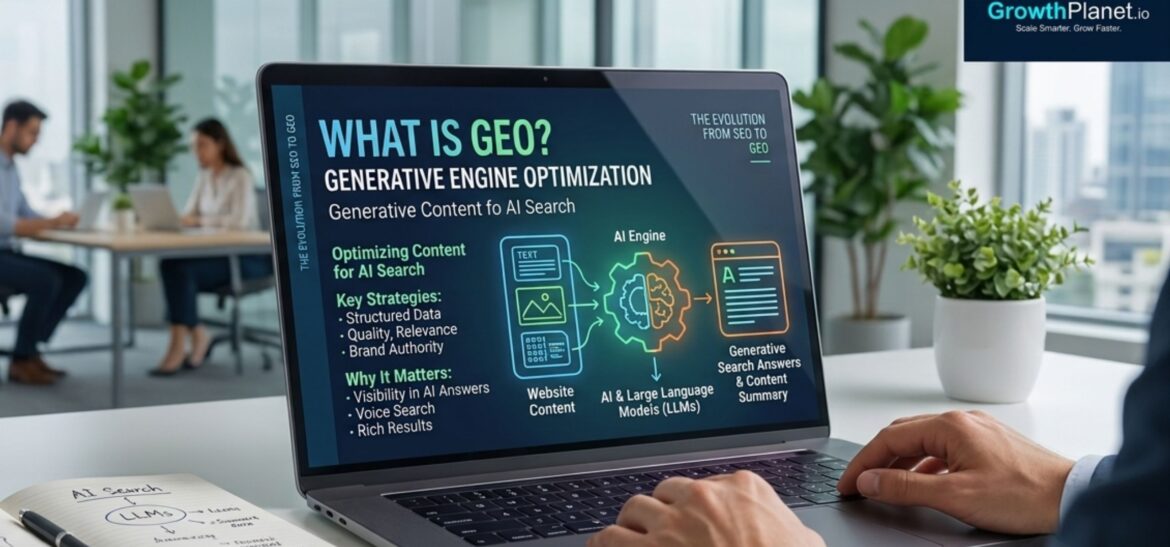
What Is GEO (Generative Engine Optimization) and Why It Matters for AI Search
If you’ve noticed your website traffic shifting lately, you’re not imagining things. People aren’t just typing keywords into Google and scrolling through ten blue links anymore. They’re asking ChatGPT, Perplexity, Gemini, and Google’s AI Overviews a question and getting a full answer on the spot, often without ever clicking through to a website. That shift is exactly why Geo (Generative Engine Optimization) has become one of the most talked-about topics in digital marketing this year.
So what exactly is GEO, and should you actually care about it? Let’s break it down.
What Is GEO (Generative Engine Optimization)?
Generative Engine Optimization, often shortened to GEO, is the practice of structuring, writing, and publishing content so that AI language models, think ChatGPT, Perplexity, Gemini, Google AI Overviews, and Claude, actually cite it when answering a user’s question. It’s sometimes called AI SEO, answer engine optimization (AEO), or large language model optimization (LLMO). The industry hasn’t fully agreed on one name yet, but they’re all chasing the same goal: getting your content picked up and referenced inside an AI-generated answer.
Here’s the key difference from traditional SEO. Classic search engine optimization is about ranking in a list of links. You want to be position one, two, or three so people click through to your site. GEO isn’t about ranking position at all, it’s about being included in the actual answer the AI gives someone, whether or not they click anywhere afterward.
How Is GEO Different From Traditional SEO?
Think of it this way: traditional SEO competes for a spot in a results page. GEO competes for a spot inside the response itself. When someone asks an AI tool a question, the system often doesn’t just search that exact phrase, it breaks the question into smaller sub-queries, searches each one, and stitches together an answer from multiple sources. This is sometimes called “query fan-out,” and it means your content might get pulled in for one small piece of a bigger answer rather than the whole thing.
Importantly, GEO (Generative Engine Optimization) isn’t a replacement for SEO, it builds on top of it. Google itself has stated that optimizing for generative AI search is still, fundamentally, a form of SEO. Brands that already have strong technical SEO, clean site structure, and authoritative content tend to perform better in AI search too. GEO just adds a few extra layers: content that’s easy to quote, rich in data, clearly structured, and genuinely trustworthy.
Why GEO Matters for AI Search Right Now
Here’s where it gets real. Recent industry research shows that organic click-through rates on Google have dropped sharply on searches where an AI Overview appears, because people are getting their answer without leaving the results page. At the same time, AI Overviews now show up in a significant share of all Google searches, and that number keeps climbing.
But here’s the part that should make marketers pay attention: traffic that does come from AI platforms tends to convert much better than average organic search traffic. People arriving from an AI-generated recommendation are often further along in their decision-making process, which means higher intent and higher conversion rates.
Meanwhile, the overlap between what ranks on Google’s first page and what actually gets cited in AI answers has shrunk dramatically over the past year. In other words, ranking #1 on Google no longer guarantees you’ll show up in an AI Overview or a ChatGPT response. That’s a wake-up call for anyone relying purely on old-school SEO ranking tactics.
How to Start Optimizing for AI Search
You don’t need to throw out your existing SEO strategy, you need to build on it. A few practical starting points:
- Answer the question immediately. AI systems tend to evaluate a page’s relevance based on its opening content. Don’t bury your answer three paragraphs in, lead with it.
- Add statistics, data, and cited sources. Academic research on GEO (Generative Engine Optimization) has found that adding statistics, direct quotes, and source citations meaningfully increases how often content gets referenced in AI-generated answers.
- Make sure AI crawlers can actually read your site. Check your robots.txt file. Some content delivery platforms now block AI bots by default, which quietly kills your visibility in AI search without you even realizing it.
- Use clear structure. Headers, bullet points, FAQs, and well-organized content are easier for language models to extract and summarize accurately.
- Build genuine topical authority. AI systems, like search engines, favor content that demonstrates real expertise rather than thin, keyword-stuffed pages.
The Bottom Line
GEO (Generative Engine Optimization) isn’t a passing trend, it’s a natural evolution of how people find information online. Search hasn’t disappeared; it’s just changed shape. As more queries get answered directly by AI rather than through a list of links, showing up inside that answer matters just as much as ranking well ever did. The brands that adapt now, by combining solid SEO fundamentals with GEO-specific tactics like citation-friendly writing and clear structure, will be the ones AI tools trust enough to recommend.
FAQs
Q- 1 Is GEO The Same As SEO?
No. SEO focuses on ranking in search results, while GEO focuses on getting cited directly inside AI-generated answers. GEO builds on SEO fundamentals rather than replacing them.
Q- 2 Does GEO Replace Traditional SEO?
Not at all. Traditional organic search still sends far more overall traffic than AI platforms combined, so SEO remains essential. GEO is an additional layer on top of it.
Q- 3 How Can I Check If My Content Is Optimized For AI Search?
Start by reviewing your robots.txt file to confirm AI crawlers aren’t blocked, then check whether your content directly answers key questions in its opening paragraphs, includes data and sources, and is clearly structured with headers and FAQs.




Home Services Marketing in Lahore: Google Ads Guide
Website Losing Customers? 15 Signs & How to Fix It