Post
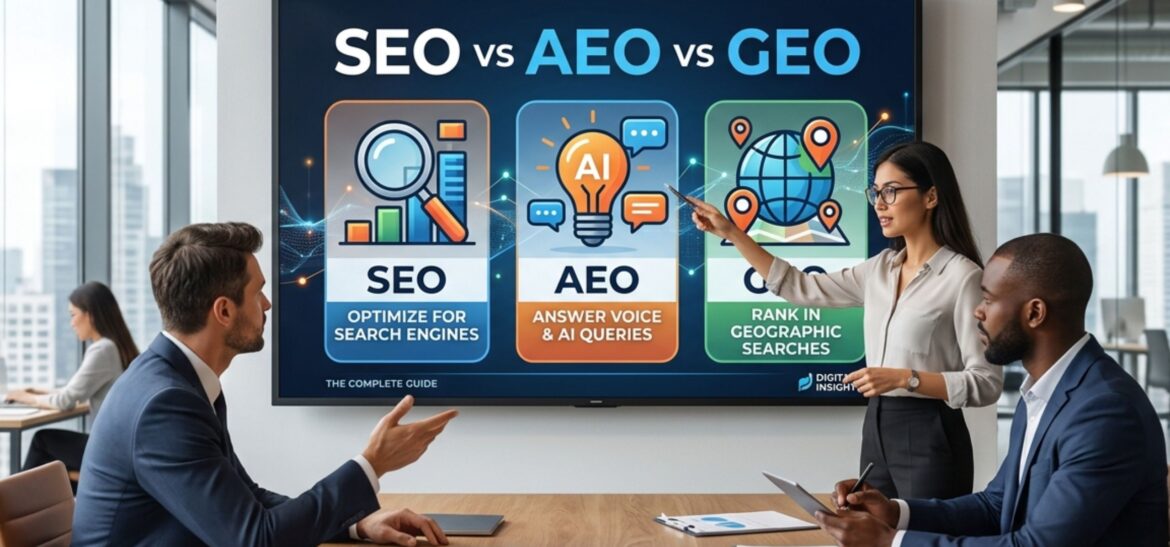
SEO vs AEO vs GEO: The Complete Guide to Ranking Everywhere
Search used to mean one thing: get your page onto page one of Google. That single goal is gone. Today, the same query might trigger a Google AI Overview, a direct answer inside ChatGPT, a Perplexity citation, or a classic blue link often all at once. If your content strategy still revolves around traditional SEO alone, you’re optimizing for a shrinking slice of how people actually find information.
This is where SEO vs AEO vs GEO stops being a buzzword debate and becomes a real business question. Each discipline plays a distinct role in the modern search ecosystem, and understanding how they connect is the difference between staying visible and quietly disappearing from the results people see.
Follow Us on Facebook, Instagram & LinkedIn
What Is SEO, Really, this Year?
Search engine optimization (SEO) is the foundational practice of optimizing pages so search engines can crawl, index, and rank them for relevant queries. It covers technical health (site speed, crawlability, mobile usability), on-page elements (title tags, headers, internal linking), and off-page authority (backlinks, brand mentions).
SEO isn’t dead, it’s the eligibility layer everything else builds on. If Google can’t crawl your site or trust your domain, no amount of clever answer formatting will help you show up in an AI-generated response, because most AI Overviews and chatbot citations are still pulled from indexed, well-ranking web pages. You can review Google’s own guidance on ranking systems in the Google Search Central documentation.
What Is AEO (Answer Engine Optimization)?
Answer Engine Optimization (AEO) focuses on structuring content so it can be extracted and presented as a direct answer, inside featured snippets, People Also Ask boxes, knowledge panels, voice assistant responses, and AI Overviews. AEO doesn’t compete for a ranking position; it competes to become the answer itself.
Because of this shift, engagement metrics are changing. Studies cited by industry researchers show that AI Overviews have significantly reduced click-through rates for top-ranking pages, since users increasingly get what they need without clicking through. That makes AEO less about traffic volume and more about brand visibility and trust at the exact moment someone has a question.
Core AEO Tactics Include:
- Writing clear, self-contained answers in the first 1–2 sentences of a section
- Using structured data (FAQ schema, HowTo schema, Article schema)
- Organizing content around question-based headers
- Building entity-first content, clearly defining who or what you are, not just stuffing keywords
- Using bullet points, numbered lists, and tables that are easy for machines to parse
What Is GEO (Generative Engine Optimization)?
Generative Engine Optimization (GEO) is the newest and broadest discipline. It focuses on how large language models (LLMs) like ChatGPT, Claude, Gemini, and Perplexity retrieve, synthesize, and cite content when generating a conversational response. Unlike traditional search, GEO isn’t about ranking on a results page at all, it’s about earning a mention or citation inside an AI-generated answer that the user never sees as a “search result.”
Research often referenced in this space — including a widely cited Princeton study on generative engine optimization, found that adding expert quotes, statistics, and citations to content measurably increases the likelihood of being referenced by an AI system. In other words, AI visibility rewards content that reads like it was written by a credible expert, not content engineered purely for keyword density.
GEO also means understanding that each platform behaves differently:
- Google AI Overviews lean heavily on top-ranking organic results
- Perplexity favors fresh, well-sourced content
- Microsoft Copilot often pulls from LinkedIn and professional network data for B2B queries
- ChatGPT search blends indexed web content with real-time browsing
You can read more about how generative systems source information on Wikipedia’s overview of generative engine optimization.
SEO vs AEO vs GEO: The Key Differences
| Discipline | Primary Goal | Where It Shows Up | Success Metric |
|---|---|---|---|
| SEO | Rank pages | Google, Bing search results | Organic traffic, rankings |
| AEO | Become the answer | Featured snippets, AI Overviews, voice assistants | Answer placements, impressions |
| GEO | Get cited | ChatGPT, Perplexity, Gemini, Copilot responses | Brand mentions, AI citations |
A simple way to remember it: SEO makes a page eligible. AEO makes the answer extractable. GEO makes the brand citeable.
Why You Need All Three Working Together
Over 60% of Google searches now end without a click to a third-party website, and that number keeps climbing as AI-generated answers absorb more query volume. Brands relying exclusively on traditional ranking strategies risk becoming invisible to a growing segment of users who never scroll past the AI-generated summary.
The good news: these three disciplines reinforce each other rather than compete.
- Strong SEO gives you the domain authority and crawlability that both AEO and GEO depend on.
- AEO structuring (clear answers, schema markup, question-based headers) makes your content easier for both search engines and LLMs to extract.
- GEO-friendly signals original data, expert quotes, and citations, build the kind of trustworthy, fact-dense content that satisfies E-E-A-T (Experience, Expertise, Authoritativeness, Trustworthiness), which benefits your search engine rankings too. Google’s own guidance on E-E-A-T is outlined in the Search Quality Rater Guidelines.
Practical Steps to Rank Everywhere
Most teams already know they should be “doing AEO and GEO”, the harder part is turning that into a workflow that fits alongside everyday SEO work instead of competing with it.
Start with how you write, not just what you write. Lead with the answer. If a section is titled “How long does it take to see AEO results?”, the very next sentence should answer that plainly, before you get into nuance or caveats. Search engines and language models both reward that structure because it’s easy to lift out of context.
FAQ schema deserves a permanent spot in your publishing checklist, not a one-off add-on for a handful of pages. The same goes for HowTo and Article schema wherever they genuinely apply, markup only helps when it accurately describes the content sitting on the page.
Original substance is what separates content that gets cited from content that gets ignored. A page built entirely from paraphrased competitor articles has nothing new to offer an AI system that has already read those same competitors. Original statistics, first-party data, and quotes from real practitioners give both Google and the LLMs a reason to point to you specifically.
The same logic applies to how you frame your brand and topics. Write about your product, your industry, or your expertise as a clearly named entity — not as a rotating cast of keyword variations. This is less about gaming an algorithm and more about being unambiguous: when a model has to decide who to credit for an idea, vague references lose to clear ones.
From there, it’s worth actually checking your own visibility instead of assuming it. Run your own brand and product questions through ChatGPT, Perplexity, and Google periodically and see whether, and how, you’re being referenced. Patterns will show up quickly: maybe you’re cited for informational queries but absent from comparison queries, or vice versa. That gap tells you exactly where to focus next.
None of this replaces the fundamentals. A slow site, broken mobile experience, or thin internal linking will still hold you back, because every system in this guide is ultimately built on top of a crawlable, trustworthy website.
Final Thoughts
There isn’t really a winner in the SEO vs AEO vs GEO comparison, because they aren’t competing for the same job. SEO earns you a place in the index. AEO earns you the answer slot. GEO earns you a mention inside a conversation you weren’t even part of. Treat them as one connected system rather than three separate campaigns, and you stop chasing rankings for their own sake and start showing up wherever your audience actually goes looking, a search bar, an AI Overview, or a chat window.
FAQs
Is AEO Replacing Traditional SEO?
No. AEO builds on SEO rather than replacing it. Search engines and AI systems still rely heavily on well-optimized, authoritative, crawlable pages as source material, so strong technical and on-page SEO remains the foundation for AEO and GEO to work at all.
How Is GEO Different From AEO?
AEO is about winning direct-answer placements inside search engines, featured snippets, AI Overviews, and similar formats. GEO is broader: it’s about how conversational AI tools like ChatGPT and Perplexity decide who to cite when they generate an answer, often in a space that never resembles a traditional search results page.
How Do I Measure Success In AEO And GEO?
Standard traffic reports won’t tell the full story here. Track featured snippet wins, AI Overview appearances, and brand mentions or citations across AI platforms, and pair that with your usual organic traffic and ranking data to see the complete picture.



Local SEO for Lahore Businesses: Get More Calls & Inquiries
Website Losing Customers? 15 Signs & How to Fix It
Google Ads Mistakes That Are Wasting Your Budget